Showing posts with label Ghana.. Show all posts

Wednesday, 25 January 2017

MARIJUANA: Ghana Moves To Decriminalize Its Use


By This Is Africa 
Ghana has revealed that a bill to decriminalize the use of marijuana has been tabled before parliament. Under the proposal, marijuana users and those addicted to the drug will receive medical care and rehabilitation, rather than prosecution. However, the scope of the decriminalisation is yet to be revealed, and it’s not clear if the decriminalisation will allow the medicinal use of marijuana. We ask, is a legal and regulated marijuana industry a feasible and good idea?

Ghana has revealed that a bill to decriminalize the use of marijuana has been tabled before parliament. Under the proposal, marijuana users and those addicted to the drug will be receive medical care and rehabilitation, and will not be prosecuted.

According to CCTV, the country’s former Deputy Minister of the Interior James Agalga said under the proposed new bill tabled before parliament, marijuana users will be given medical care and rehabilitation, rather than incarceration. The government will reportedly assist those who grow the plant to find an alternative means of earning money.

However, the scope of the decriminalization is yet to be revealed, and it’s not clear if the decriminalization will allow the medicinal use of marijuana.

The proposal will undoubtedly ignite debate amongst Ghanaians considering the contentious nature of the issue.

Debates on the legalisation of marijuana have been growing across the continent, with proponents of legalisation citing its economic value. Campaigners have been pushing for the legalisation of cannabis in Swaziland, which is illegally grown by some of the country’s poorest, who make a living by selling the crop.

Editorial
PETROL PRICES
It is a fact that the people of Ghana expect substantial reductions in the price of petroleum products under President Nana Addo Dankwa  Akufo-Addo.

The expectation is not misplaced because it was the New Patriotic Party (NPP) and its Presidential candidate who made the promise to reduce the price of petroleum products with their senses intact.

However, the truth is that a sudden and drastic reduction in the prices of petroleum products ought to be accompanied by revenue generation measures which will make it possible to run the business of government smoothly.

The people deserve relief from the high prices of petroleum products but tackling this problem ought to be done responsibly.

This is the task before the Akufo-Addo Government.

MORNING AFTER THE NIGHT BEFORE
Nana Akufo Addo
By Charles Wereko-Brobby
The title of this piece is a common English expression that describes one’s physical state after tasting too much of the fruits of the Lord Jesus’ inaugural miracle in joyous celebration. (And before any Pastor tells me the fruits were non-alcohol, I want to state firmly and categorically that I have been to many a Jewish wedding, and do not share their assertion).

Ghana has had a lot to celebrate in the last month. We kicked off with the conduct of a very orderly General Election which confounded all, the frightening predictions of the Doomsday Predictors, both Peace Mongers & Pastoral. The outcome was cause for both wide celebration and gnashing of teeth. Whichever one it was, it led to a very copious consumption of the fruit of the inaugural miracle; according to my “Spot” -owning pal.

Hardly had we recovered from our “tired & emotional” state and the sharp pains of the inevitable headaches, when Christmas came upon us. Every Ghanaian living everywhere knows that “Bronya” is the real McCoy, the moth of all celebrations. This year's was especially sweet as the retailers gave us all handsome presents with substantial reductions in the prices of the goodies we needed to “chop” Christmas. I am too sure that the sellers of “inaugural fruit” were so charitable with price reductions. Nevertheless, there was considerable uptake of the “inaugural fruit”, made possible by the savings from reductions in the prices of “akoko”, “pioneer biscuit”, perfumed rice, etc.,

The mother of all celebrations was the inauguration of the 5th President of Ghana, Nana Akufo-Addo on January 07 2017. The parties were several, long and full of quaffing of the “inaugural fruit”. And it was right and fitting that a good time was had by most, if not all Ghanaians, that CHANGE HAD COME and Happy Days were on the horizon, if not here again already. Going by the localized interpretation of Newton’s third law that “Input begets Output”, the post celebration pains, headaches and attendant dehydration were more intense, sustained and not just on account of taking in too much of the “inaugural miracle fruits”


President Akufo Addo (I will get used to the transition from “Addo D”) delivered a very inspiring inaugural speech, which made me and everyone else who heard it “very proud to be a Ghanaian”, whether they hold the passport or not. Alas hardly had we imbibed the promise of the new and exciting dawn of a new Ghana with responsible citizens “mucking in “instead of sitting on the fence “carping”, when the ‘s**t literally hit the fan” with worrying revelations about unattributed portions of the speech. Note, I do not use “plagiarism” for the simple reason that we are dealing with a few passages of an otherwise well-constructed and visionary 'call to arms' to all Ghanaians to pull our country up by the local equivalent of bootstraps.

After, the acting Director of Communications at the “Golden Jubilee House” (first manifestation of Change) quickly put up the proverbial “it’s a fair cop, Gov” apology post on Facebook (not the most appropriate medium), the matter should have and could have ended there, and we could have all moved on to better digestion of His Excellency’s message.  Unfortunately, the matter was not put to rest because too many “toono” “gaping sycophants’ started producing contorted academic thesis on copyright laws and even going to the extent to suggest that no infractions had occurred. That was as stupid as it was unmeritorious.

Let’s get one thing straight from the word go. The Opposition NDC is in an automatic payback mode. It has hit the ground running and will operate on the well-worn principle that “The business of the Opposition is to oppose everything and offer no solutions”. By getting the mandate of the people of Ghana on 7 December 2016 President Akufo-Addo and his party shifted from the “Problem Articulators mode to SOLUTION DELIVERERS. It does not have the luxury to engage in responding to every provocation from the NDC or encouraging their supporters to offer a “Pavlovian” (knee jerk”) response. I would have thought we would have learnt from the many Fasts and Thanksgiving services that there is only one infallible being, and we mere humans will continue to make mistakes, and just get used to the idea that we must apologise and ask for forgiveness, learn the appropriate lessons for the future, no matter how lofty our position is.

The second piercing and persistent headache has been the saga of the resettlement of ex-President John Dramani Mahama. It is an episode in which none of the players comes out smelling of roses: not Ex-Presidents Kufuor and Mahama; not President Akufo-Addo; not the Transition Teams: and last but not least, not the Parliament of the Republic of Ghana. I leave out Otumfuo for the simple reason that his involvement, if any, was engineered by actors who were very familiar with the laws of the Republic of Ghana, and should have ensured whatever intervention they sought from His Majesty was firmly grounded in the laws of Ghana.

Parliament was wrong in first accepting and then overriding the recommendation on accommodation arrangements by the Committee the President set up to review Article 71 end of service benefits. Be that as it may Ex-President Mahama was clearly wrong in seeking to perpetuate the misdemeanor of appropriating the official residence of the Vice President of Ghana, when he became the President of Ghana. If he had moved into the expensively refurbished Presidential Residency at the then Flagstaff (now Jubilee) House, all the subsequent cacophony will have been avoided. Ex-President Kuffuor’s interjection was unnecessary as it was unhelpful. The position advanced by his Spokesman is not found in our law. As far as I can surmise, Parliament approved the allocation of a house, NOT a specific house or a choice in the house.

Most troubling has been the shifting and contradictory position of Government. Clearly it appears it has had to back away from “smoke room” agreements which are not lawful and more importantly perceived by the people of Ghana as unfair, excessively wasteful and laying precedents that would be unsustainable going forward in the future.  In withdrawing from this sordid episode, former President Mahama has hinted at agreements precedent to the issuance of the formal announcement by the former Chief of Staff.  I believe it is incumbent, nay imperative, for the government to confirm or deny the claims impugned by the Ex-President, not least for the sake of removing the obvious embarrassment to Otumfuo Osei Tutu II, who does not need this distraction at this most difficult time for him.

Last but not least is the issue of takeovers of state structure and properties. Yes, the IGP and the Police must be up and doing without giving excuses.  Up and doing needs more than asking for a Plan to be drawn up when swift and decisive restoration of law & order is what is needed NOW. But the Police need the clear support of Government to do its job. So far this has not been forthcoming, a very worrying turn of events. 

Freddie Blay
For me, it is not good enough to point to the pleadings of party leaders as sufficient. Indeed, the reported comments and posture of the Ag. National Chairman of the NPP, Freddie Blay has been disappointed in the least, and damn right irresponsible at best. There is a clear distinction between Party, which is necessarily partisan, and Government, which must see itself as acting on behalf of ALL the People of Ghana. The sooner the transition from the former to the latter is completed, the better it will be for President Akufo-Addo & his avowed commitment to the “Rule of Law”, and to the benefit of every Ghanaian living everywhere, who voted for CHANGE OR CONTINUITY.

We have enjoyed a wonderful season of celebrations. However, it’s now time to take some pain killers, douse loads of water on ourselves to cure our harmattan compounded dehydration and sober up quickly to tackle the many onerous tasks ahead. President Akufo seems to have sobered up already. He has set the record for the quickest nomination of Ministers in the 4th Republic of Ghana. This means that Ghana will have a full functioning Government by the end of January, very impressive when put against the 3-4-month period of all previous Governments.

Its time for everyone else to clear their heads and wake up to the challenges of the Citizen-led renewal of our Country emboldened by the “Proud to be Ghanaian “Spirit.       
 
Charles Wereko-Brobby
Ghana Institute for Public Policy (GIPPO)

THE ADDO "D" YOU DID NOT KNOW
By Charles Biney
Around mid-1979, as a very young politician, my path crossed that of a gentleman I could hardly  figure  out, but was very curious to know what he was about in politics. I was then the Organizing Secretary of the United National Convention Party for the Ga Rural Constituency. Also, I was actively involved in the politics of the Akim Abuakwa Constituency any time I visited my parents.
President Nana Akufo Addo

At that time, the Akim Abuakwa Constituency was badly in search of a parliamentary candidate. The name that kept popping up was one Nana Addo, someone I was hearing of for the first time. The leadership of the local party decided to draft him as the parliamentary candidate for the constituency, though we had not had any prior consultations with him. To the chagrin of the constituency, the national leadership, without our involvement, decided to impose a candidate on us .  We swore to register our displeasure at the appropriate time. Opportunity knocked at the door on the day that the flag bearer, Paa willie was slated as a speaker at a New Tafo rally - it was quite a spectacle to behold.

Just before Paa Willie was to speak, some of us grabbed Nana forcefully and lifted him shoulder high. To our disappointment he resisted forcefully no matter how hard we tried. We did not understand him then, and wondered why he would refuse a gesture his contemporaries were yearning for.

I didn't set eyes on him again for years. However, around the early nineties, during the second liberation struggle for the restoration of democracy and the rule of law, once again, our paths crossed.

This time I had the opportunity to work with him closely. He called me Charlie B, and I called him Addo D - that has changed since January 7, asymmetric change, though - whilst he can continue to call me Charlie B, he, to me, is now either Mr President or Your Excellency!

It was during the prosecution of the struggle and the years after that I realized Nana Addo is the most grossly misrepresented politician of our time - mauled by his detractors and critics. I discovered someone who was willing to stand on the side of the suffering masses while checking the power of the highest- a man who puts the needs of others first and helps people to perform.

Though unjustifiably bastardized by the rented press and his opponents, he still prevailed with his deft strategies and coolness in the face of relentless and needles attacks.

Also, under unfair attacks, innuendos, and shenanigans, he admonished his supporters to remain calm and not respond in kind. Even when he disagreed with the Supreme Court verdict, as regards the 2012 election petition, he accepted it and calmed the whole nation that was on the verge of civil strife. That's quite a telling perspective, isn't it? Putting the interest of the nation above his parochial agenda. Alluding to Mark Anthony's speech, I may ask, is this an ambitious person determined to rule his nation at all cost, as his critics want us to believe? ABSOLUTELY NOT!

After almost four decades, I saw in him a number of leadership qualities; however, the attributes I admire most about him are his altruistic and self-giving tendencies, and that's what I think will make him a very successful and great leader.

THE CAUSE...?
OF COURSE, ENDURES!
AND THE BATTLE...?
STILL THE LORD'S!!

Charles Biney
Dallas, Texas, USA

Guantanamo Bay turns 15: A look back at the notorious ‘torture camp’

A detainee is carried by military police after interrogation at Guantanamo Bay
Guantanamo Bay Detention Camp opened its cells to terrorist suspects 15 years ago, on January 11, 2002. Torture, unlawful detention, and hunger strikes have marred the US detention facility ever since.

Fifteen years on, the camp remains open, despite President Barack Obama’s campaign promise to shut it down, while president-elect Donald Trump tweeted earlier this month that he believes there should be no more prisoners released from Gitmo.

Over the years, close to 800 prisoners have been detained, and in some cases tortured, in the detention camp, using what were called “enhanced techniques” on the prison population, the overwhelming majority of whom were never charged.

Such “techniques” included waterboarding, with numerous detainees subjected to prolonged sessions of this potentially deadly torture, as well as being stripped naked and being confined in dark cells for lengthy periods of time.

A Somali detainee at Gitmo, Guleed Hassan Dourad, said he was also subject to “mental torturing,” describing during a pretrial hearing last year that he recalls vibrations in his cell floor, a constant “stinky smell” and noises that sounded “like someone on the roof… hitting hammer.”

A November 2016 study from Afghan Analysts Network found the US authorities committed “gross miscarriages of justice” against the victims, many of whom were detained on scant evidence. It found that in regard to the eight longest-serving inmates, the military were unable to “substantiate its accusations.”

Ex President Barack Obama
“Almost anyone could be detained,” said the report’s author Kate Clark, adding that “meaningless strings of associations – detainee knew X who knew Y who knew Z who knew bin Laden – [were] put forward as evidence of wrongdoing.”

Nine prisoners have died in Guantanamo, and seven of those deaths are believed to be by suicide. Only nine prisoners have ever been convicted of a crime. Today, 55 prisoners remain on the island, with 19 cleared for release – five of whom were cleared in 2009.

On the 15-year anniversary of its opening, RT looks back at some of the detainees who have spent years inside Guantanamo Bay.

Guantanamo has housed at least 15 children within its cells. Omar Khadr was 15 when he was sent to Guantanamo after being picked up in Afghanistan in 2002.

The Canadian pled guilty to throwing a grenade at a soldier in Afghanistan – after 8 years in Gitmo, his lawyers say he confessed under torture. Khadr is the only child soldier prosecuted in a military commission for war crimes.

He was transferred to Canada to serve the rest of his time. He has since become engaged to a woman who campaigned for his release.

Mohammed el Gharani was 14 when he came to Guantanamo – its youngest prisoner ever. Falsely accused of fighting for the Taliban and being a member of a London Al-Qaeda cell, el Gharani had never been to Afghanistan or the UK.

He was released in 2009, after seven years of being “abused” and not being treated like a child.
Mohamedou Ould Slahi, a Mauritania national, penned a bestselling memoir called Guantanamo Diary during his time in the prison camp.

A victim of torture and 14 years of detention without charge, Slahi was released in October. Slahi had given himself up to local authorities for questioning after 9/11, and was transferred to US custody

ami al Hajj, an Al Jazeera cameraman from Sudan, al Hajj was detained in 2001 and released in 2008. The only journalist to be held at Gitmo, he took part in hunger strikes.

Shaker Aamer was the last British detainee held without a trial. Since his release in October 2015, Shaker has spoken out about the conditions in the prison.
“Guantanamo is being run by one concept: how to destroy a human being,” Aamer told RT last year.

Mustafa al-Shamiri, a Yemeni, has spent 14 years in Guantanamo over a case of mistaken identity, with US authorities claiming he was a senior Al-Qaeda trainer in Afghanistan. Despite being cleared for release over a year ago, he remains detained there.

Abdallah al-Ajmi, a Kuwait citizen and former Taliban fighter, was sent to Kuwait from Guantanamo in 2005, where he was acquitted in 2006. He went on to die in a suicide bomb attack he carried out in Mosul in 2008.
Abedlaziz Kareem Salim al-Noofayee was detained in March 2002 for wearing a Casio F91W watch, which intelligence identified as a terrorist watch, or the “sign of al-Qaeda.” He was released in 2009.

Khalid Sheikh Mohammed is an alleged 9/11 plotter. Born in Pakistan, he has been dubbed “the mastermind of the September 11 attacks.” He was captured in Pakistan in 2003 and was transferred to Gitmo in 2006. He was waterboarded at least 183 times.
He remains in Guantanamo along with fellow plotters Ramzi bin al-Shibh, Abd al Aziz Ali, Walid Bin Attash, and Mustafa Ahmed al-Hawsawi.


VINDICATED: The Story We Published On Drone Attacks In March Last Year

A drone
By Duke Tagoe 
A “drone” has attacked and caused severe injuries to 28 years old Issah Salifu, a bartender at the Asabea Spot at Kokomlemle in Accra.

The accident occurred Sunday afternoon on the Hearts Lane adjacent the Old Press Centre in what eyewitnesses described as a frightening incident.

According to Issah, he was walking on the Hearts Lane when he was struck heavily at the back by what he called a “small helicopter”. He fell to the ground and swellings started forming around his face and the limbs.

Issah was immediately rushed to the Cocoa Clinic at Kaneshie but was later referred to the Korle Bu Teaching hospital where doctors subjected him to bouts of injections and a prescription of what he described as expensive medicines.

The owner of the drone whose name has only been given as ‘Sam’ is alleged to have told neighbors around the Hearts Lane, that he is a staff of the Brazilian construction company Queiroz Galvao currently constructing the magnificent overpass at the Kwame Nkrumah Circle.

According to ‘Sam’ he was mandated by the company to put the drone in flight to take pictures of the overpass at a certain distance in the sky, but lost control of the drone a few minutes after it went into flight.

Doctors also prescribed Naklofen duo 75 mg, Salicyclic Acid Ointment and Rubaxin Tablets for Issah.

Naklofen is a nonsteroidal anti-inflammatory drugs with analgesic and antipyretic action. It is used for the treatment of all rheumatic diseases and for the alleviation of different types of pain and other pain syndromes in injuries and after other surgical procedures in the kidneys.

“Sometimes when I wake up in the morning I feel a very sharp pain in the area around my backbone and I have difficulties standing for long hours. I hope that my pain will go away after I complete my medication” Issah told this reporter.

A drone is a small aircraft piloted by computers on board or by remote controls on the ground. They are often used for military purposes because they don't put a pilot's life at risk in combat zones. However, with the advancement of technology, drones can now be produced for commercial use.

In North America and in other parts of Europe, where there is the increasing use of the drone, there are guidelines that demand that drones must stay less than 400 feet above the ground and steering a drone over someone's house could be considered a trespassing violation.

A drone can also be used for wide ranging activities including espionage and other activities.  In Ghana, it is beginning to manifest that there isn’t any special regulation for the use of the drone in spite of an upsurge in the use of the unmanned aerial vehicle. A lot more must be done to put in place the necessary legal framework that governs the use of such aerial vehicles to check against abuse.

Our Editorial on Regulating Drones
We carried last week the story of a victim of a drone incident. The incident which occurred at Kokomlemle was described by eyewitnesses as frightening.

It emerged later that the drone belonged to the Brazilian company Queiroz Galvao which was using it in its work.

But the incident should move the authorities to put in place the regulatory framework for these aerial vehicles which are increasingly becoming part of the aviation landscape in the country.

A number of companies and individuals now own these vehicles, but so far there appears to be no proper system for regulating them.

With time, their numbers are sure to increase and if the country does not act to the control their movement, we are sure to have confusion in the skies.

Even in the more advanced countries, there have been troubling incidents involving drones.

Luckily we have been alerted.
The time to take action is now!

Editorial
LET’S ACT NOW
About a year ago, The Insight drew attention to the danger posed by the acquisition of drones by individuals and companies and we urged the authorities to take steps to regulate their use.

Nobody paid any attention until a media house allegedly used a drone to film the residence of former President John Dramani Mahama last week-end.

Drones can be weaponised and they pose danger to civil aviation.

The Insight insists that if the use of drones are not properly regulated it will soon pose a serious danger to national security.

Our stand on drones has not changed and we call on the authorities to take appropriate action now to control the use of drones.

We cannot delay on this matter.

Against the Odds: Rawlings and Radical Change in Ghana
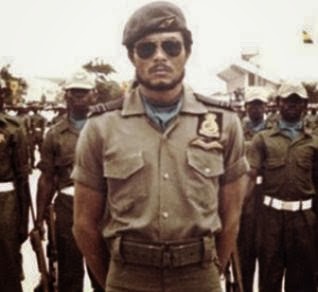
Jerry John Rawlings
By ROAPE
Ghanaian activist and socialist Explo Nani-Kofi describes his involvement in a period of radicalisation in Ghana in the 1970s and 1980s. The period found its figurehead in the charismatic leadership of Flight Lieutenant Jerry Rawlings. 

In face of widespread discontent Rawlings attempted a coup d’état on 15 May 1979, against the military government led by General Fred Akuffo. The coup failed and Rawlings was arrested and imprisoned. He began to speak in the language of the left and attracted the interest and support of Ghanaian socialists and radicals. On 4 June, Rawlings was broken out of jail by soldiers sympathetic to his politics, he then led a rebellion of the military and civilians against Akuffo. The Armed Forces Revolutionary Council (AFRC) was established under his leadership, promising to clean-up Ghana of corruption and injustice. 

The AFRC organized an election in September 1979 which was won by Hilla Limann of the People’s National Party (PNP). The civilian administration quickly ran into difficulties, of its own making. In 1981, after a strike wave paralysed the country, the government declared that in the event of further action all strikers would be arrested. The strike movement helped precipitate the collapse of the Limann administration. It was clear that the new democratic government was unable to fulfil its promises of real change across Ghanaian society. On 31 December 1981 Rawlings, with soldiers and the support of some left parties, launched a second coup and overthrew the Limann government. The Provisional National Defence Council (PNDC) was set-up with Rawlings as Chairman. Before long the possibility of radical change in Ghana gave way to repression of his left-wing allies, and a gradual retreat from the promises of pro-poor transformation. After several years, left-wing opponents were imprisoned and at the same time the regime became a test case for structural adjustment. 

Rawlings oversaw the introduction of the Economic Recovery Programme and called for ‘austerity and sacrifice’. By 1987 Rawlings the revolutionary became the darling of the IMF and the World Bank. In this ROAPE interview Nani-Kofi explains what some of the experiences were for activists on the ground.

Explo Nani Kofi
Can you first of all tell me briefly who you are and your political background in Ghana?

I am Explo Nani-Kofi and at present the Director of Kilombo Centre for Civil Society and African Self-Determination which is a research, education and advocacy institution, which I have been developing as a social justice practitioner and grass root organiser. Through that I coordinate the International Conference on Africa, Africa and Social Justice every September in Peki, Ghana. I come from Peki and was born in Anfoega, both in the Volta Region of Ghana. When I was a child, relatives, family friends and neighbours were officials in Kwame Nkrumah’s Convention People’s Party (CPP) so I grew up in an atmosphere of CPP influence.

In secondary school, I got involved in the Current Affairs Society and came across The Dawn, published by CPP Overseas, and Amanee published by Central Union of Ghana Students in Europe, which were Nkrumahist oriented publications which were being sent discretely into the country. All this was given as orientation when I was starting secondary school in 1975, when my teacher was the Marxist-oriented Mahama Bawa. I then founded and became President of the Students Movement for African Unity (SMAU) in my school, Mawuli Secondary School in Ho.

Having been in SMAU, when I entered university, I looked out for the SMAU branch. Initially there was a SMAU note on the notice board and when I followed it I was introduced to the Pan African Youth Movement (PANYMO) then led by Chris Buakri Atim. [1] Atim was the Acting President of the National Union of Ghana students (NUGS) and I ran errands for him to the other universities often circulating press statements. By the time of 31 December 1981 coup d’etat, I was the 1st National Vice President of NUGS.

Dr Kwame Nkrumah
Can you describe the atmosphere in Ghana at the time, in the 1970s and 1980s?
On 24 February 1966, the first post-independence government of Ghana was overthrown through a coup d’etat by police and army officers of Ghana with what has been shown now to have been influenced by western intelligence services. Ghana was then ruled by a military junta of the National Liberation Council (NLC). The NLC organised elections in 1969 which were won by Dr. K. A, Busia and Progress party (PP) which was the successor party to the United Party (UP) which was the Right-wing opposition to Kwame Nkrumah’s government. The Nkrumah regime was the 1st Republic so this became the 2nd Republic.

The 1970s started with the devaluation of the currency by 48% on 27 December 1971 after the Pan-African atmosphere created by Kwame Nkrumah’s government was disrupted by the introduction of the Aliens Compliance Order policy which expelled Africans from Nigeria, Mali, Niger and other countries who had been living in Ghana. Radical student movements brought up the question of the declaration of assets by the politicians of the 2nd Republic. In response to this situation the right wing government of Dr. Busia was overthrown by the Ghana Armed Forces. The military government was initially popular with its Operation Feed Yourself programme, a declaration was made that we will not pay imperialist imposed debts and we will support African liberation movements. Gradually, the military regime grew corrupt and institutionalised the bureaucratic structure in 1975 by dissolving the original council and replacing it with a council of military generals. The military regime tried to institutionalise its rule and stop any transfer to civilian constitutional rule with the campaign for the so-called Union Government. As the regime became corrupt, the student movement grew more radical.

Before 1976, the external wing of the Ghana students’ movement was led mostly by those who won scholarships to study outside during Kwame Nkrumah’s regime. In 1976, the external students’ movement (Central Union of Ghanaian Students in Europe) integrated with the students’ movement back home under the umbrella of the National Union of Ghana Students (NUGS) and adopted scientific socialism, which created a crisis as the students’ movement was a mass organisation of all students in a neo-colonial state and such a programme and commitment seemed inappropriate.

The students’ movement together with professional bodies mobilised against the military regime. The students of Ghana had a national demonstration against the military regime and its Union Government campaign on 13 May 1977 resulting in the closure of the universities. Since that day, the week including 13 May each year came to be celebrated as Aluta Week with demonstrations and other activities. The military regime had a referendum on its Union Government in 1978 and rigged the referendum results declaring that the population had endorsed it. Further opposition created a crisis in the military regime leading to a palace coup that year. In 1979, during the Aluta Week, a hitherto unknown Air Force Flight Lieutenant by the name J. J. Rawlings took advantage of Aluta Week and attempted a military uprising on 15 May 1979 which failed; he was arrested and together with others brought to trial.

How do you assess the legacy of Kwame Nkrumah?
Kwame Nkrumah rose to become the main leader of the struggle against classical colonialism since his return to the Gold Coast, as Ghana had been named by the colonial power, in 1947 upon invitation by United Gold Coast Convention. In 1949, he led a breakaway which constituted itself as the Convention People’s Party and became more rooted in the masses of the population and was also more radical in its demands for self-government. Another great plus of his legacy is that the party was national in character and not dominated by a particular ethnic group as has been a weakness of certain political parties and ‘nationalist’ movements in other parts of Africa.  As the immediate post-independence government, the Nkrumah administration embarked on the construction of infrastructure, provision of social services to the population, developed an industrialisation programme and provided employment in a way that cannot be compared with any government since. Kwame Nkrumah’s commitment to African unity, liberation and self-determination raised his stature throughout the African continent and the African diaspora triggering a movement for revolutionary Pan-Africanism. He wrote books together that made an enduring contribution to revolutionary Pan-Africanist theory. All together this posed a threat to the efforts by the west to continue the neo-colonial control they had in Africa. As a result of this the CIA influenced his overthrow on 24 February 1966.

After his overthrow, the political class, including some who had worked with him, came to a consensus that lacked  his vision, an ‘agreement’ I have referred to as the ‘24 February 1966 Consensus.’ A number of the leadership and activists of his party integrated with others who had fallen out with Kwame Nkrumah to constitute new political parties. Any form of resistance was patchy. Four people were tried for a plot to bring him back to power. There was a counter coup attempt on 17 April 1967 but it is still unclear whether it was linked to Nkrumah. The only political party which departed from this consensus and maintained a genuinely pan-African vision was the People’s Popular Party led by Dr Willie Kofi Lutterodt and Johnny F. S. Hansen. This party brought together CPP elements who refused to accept the 24 February coup as a fait accompli and a group of activists with links to internationalist socialist movement. [2] However, Nkrumah’s influence developed among a younger generation of activists within the youth and students. By 1981, there were so many organisations inspired, in one way or another, by Nkrumah’s legacy and politics.[3]
The conflict between Rawlings and these organisations during his rule from 1982 to 1992 led to a collapse of many of these organisations. In lieu of a movement, the dominant application of Nkrumah’s politics in Ghana today is to use reference to pro-Nkrumah politics to attack one of the main opposition parties as a group responsible for his overthrow. That has not helped in practice but has rather been a distraction that creates confusion about what the emergence of the two main political parties in 1992, despite their struggle for (and against) Nkrumah’s legacy. What determined the political divide in 1992 was the attempt to shore up neo-liberal tyranny of Rawlings regime against the struggle to open the democratic space to enable genuinely civilian rule. Rawlings regime succeeded in infiltrating the pro-Nkrumah movement by taking advantage of contacts they had with the left’s tragic flirting with Rawlings’ fake radicalism in the 1980s. In the process there are a number of people who were in pro-Nkrumah movements but became members or supporters of the neo-liberal New Patriotic Party that was founded in 1992; they saw the NPP as the only effective way to stop the military regime’s structure reorganising itself into a party under the umbrella of the National Democratic Congress also set up in 1992.

Jonny Hansen
You were involved in the left movement in Ghana. How were you engaged?
I was involved in the Kwame Nkrumah Revolutionary Guards (KNRG) which emerged as a result of the People’s National Party, it was perceived as the successor party to Kwame Nkrumah’s Convention People’s Party. The KNRG was formed by Nkrumahists (adherents Kwame Nkrumah’s Pan-Africanist and socialist-oriented vision of politics) who were disappointed in the PNP so decided to organise as Nkrumahists with the guidance of his revolutionary Pan-Africanism vision of socialist transformation. I also organised students and youth under the banner of the Students Movement for Africa Unity (SMAU) which I was a member of since my secondary school days. The KNRG organised events to mark Kwame Nkrumah’s birthday and memorials for his death and on those occasions reflected on and analysed the national and international situation and looked to advance the cause of socialism and Pan-Africanism. One important forum which brought together all left-wing forces was the Progressive Forum of 3 October 1981.

From June 1979 to September 1979, the Armed Forces Revolutionary Council (AFRC), under the chairmanship of Flt. Lt. J. J. Rawlings which was a populist regime and reduced prices, executed military officers for supposed corruption and was very popular with the radical forces. This presented a very difficult situation for the successor civilian regime as the shops had been emptied The experience under the AFRC raised the expectations of the Ghanaian population which could not be met under civilian constitutional rule, conditions which were totally different from the populist military. The situation worked to the advantage of the Rawlings regime as people developed a sort of euphoria for the AFRC days and therefore Rawlings became increasingly popular.

There were a number of groups sympathetic to Rawlings – like June 4 Movement, New Democratic Movement, Movement On National Affairs, Pan African Youth Movement, People’s Revolutionary League of Ghana  – the majority of these groups became sympathetic with Rawlings with only the Movement On National Affairs (MONAS) coming out openly against Rawlings. MONAS supported a call for a probe of the AFRC and also stressed the anti-communist statements of the AFRC as well as his attacks on Kwame Nkrumah and support for the overthrow of the Kwame Nkrumah regime. I was close with groups on both sides with some of my closest friends were in MONAS.[4]

You were involved in an initiative of setting up workers committees in the Volta region under the June 4 movement before the 31 December 1981 coup d’etat. Can you give us some personal background to these initiatives and explain what happened and what went wrong?
In August 1981, through a meeting involving the June 4 Movement, Pan African Youth Movement and Kwame Nkrumah Revolutionary Guards with the support of Prof Mawuse Dake a programme of Workers’ Committees was launched under my coordination.[5]  These were decision-making and mobilisation committees of workers to raise consciousness and also to work as a group on political issues. These committees were political discussion groups, they organised community and work places , were involved in clean-up activities and also holiday classes for students as well as revision classes for those who had failed school certificate examinations and were resitting.

After the 31 December 1981 coup d’etat, the People’s and Workers Defence Committees were established as organs of popular power. Chris Atim, under whom I worked in the students’ movement, became a member of the ruling Provisional National Defence Council (PNDC) and national coordinator of defence committees. He appointed me the Regional Coordinator of the defence committees in the Volta Region. A former editor of the NUGS, Zaya Yeebo, was appointed PNDC Secretary for Youth and Sports, I was also appointed the Regional Political Coordinator of the National Youth Organising Commission. Being responsible for the defence committees and the youth movement made me the main contact with mass organisations in the region.

With the help of the committees, we organised the Defence Committees as units of community and workplace decision making. They helped with the distribution of goods and services. They arranged to get implements for work on farms and equipment for fishers. They were also a forum for political discussion where national and international issues could be raised by ordinary people.

As this involved the political activity of a left-wing nature it was mainly based in bigger urban centres like Accra.  Yet I made efforts to get experienced organisers from the capital city of Accra, to assist us in the Volta Region. I requested the release or secondment of cadres from the capital. It was in this respect that I worked with Kofi Gafatsi Normanyo and Kwame Adjimah from the National Secretariat of the Defence Committee in Accra, and the secondment of Austin Asamoa Tutu from his workplace, the Architectural and Engineering Services Company (AESC), to work with our regional secretariat of the Defence Committees.
However, the way we did things was different from how the bureaucracy wanted things to be done – our involvement directly radicalised the government. For example, when there was water shortage in the city, we didn’t see why we should have water where we stayed in student accommodation whilst ordinary people didn’t have water in town. So we opened our university accommodation for the ordinary people to come and draw water from the university. We tried to break down the barriers between ordinary people and political leaders.

Contradictions in the regime and with its support base became intolerable. It turned out that the PNDC Chairman, Rawlings, wanted to have a typical military junta and did not want to see genuine popular organs of power but to have them just as supporters to shore up the military junta. This and other issues led to a total breakdown and misunderstanding within the ruling council on 28 October 1982 and Rawlings felt that he and the two members of the council most active in the defence committees, Chris Atim and Alolga Akata Pore, had to go their separate ways but the exact details were not known to the public, including to organisers like me. After that conflict, Chris Atim addressed a public rally in Ho where I was based.

When there was a coup attempt to overthrow the PNDC on 23 November 1982 which failed, Rawlings took advantage of the situation to frame those he considered to be his enemies.  In our naivety, many of us didn’t know that we had been declared enemies. So on 24 November, Rawlings descended on the official residence of the PNDC Secretary for Youth and Sports with a helicopter and a fully armed platoon of soldiers. I was there at the time. He insisted that all of us he found there kneel down in public with guns cocked at our heads. After that, he declared two of our colleagues – Nicholas Atampugre and Taata Ofosu – were under arrest and directed the soldiers to take them away to be detained. Later, on 7 December I was invited to a meeting at the barracks and when I got there I was arrested and told that the Army Commander has directed that Kwame Adjimah and I were to be arrested and detained by the military. With the division in the ruling council, things started taking regional and ethnic lines. My closeness with Chris Atim, who is from the North, was interpreted to mean that I was an obstacle to Rawlings being in control of his home region. It was felt that I had to be removed so that it would be easier for Rawlings to control his own region. This was a tragic ethnic turn by the regime.

At the time many saw Jerry Rawlings together with Thomas Sankara in Burkina Faso, in the north, as figures committed to radical transformation in Ghana. This was never your position. Can you explain why you took such a stance on Rawlings? How did you characterise him (as opposed to Sankara) at that time and now?

There are substantial differences between Rawlings and Sankara. Sankara was a visionary because he took theoretical study very seriously as a sympathiser of communist groups in Burkina Faso. This is why we can quote Sankara today on issues like third world debt, African self-determination etc. Sankara was also very clear about the anti-imperialist struggle. Rawlings didn’t have the discipline or the theoretical mind of Sankara. When Rawlings was recruited into the Free Africa Movement, he saw such study and discussions as a waste of time and rushed recklessly into an attempted uprising on 15 May 1979 which failed woefully and put the lives of all he was associated with in danger. He was a populist who incited the population without any clear vision of a way out. For those outside Ghana, who didn’t see his weaknesses, recent revelations that he received financial gifts from the corrupt Nigerian military tyrant, Sanni Abacha, expose Rawlings’ opportunist character. Facts which are available today show that Rawlings is an opportunist who had other frustrations with the military authorities. These included his financial problems as a result of spending too much money on drinks and his army book shows his difficulties in passing promotion examinations and even the inability to handle his household responsibilities that senior officers had to intervene in all these matters.

After a very difficult period you travelled to Czechoslovakia in 1984 and then to London in 1989. Can you explain your experiences there? What did it teach you about the communist bloc? What were your impressions, experience of racism etc?
Having fallen out with the Rawlings government in 1982 I was in military detention until a military uprising and jail break on 19 June 1983 in which political detainees from three major prisons in Ghana and various military guard rooms managed to escape. I joined the military uprising and jail break. The military instructed that anybody who saw those of us escaping should shoot us on sight. Some of my comrades were caught and killed but I was able to escape to Togo by the end of June that year.

In 1982, I was awarded a scholarship by the International Union of Students (IUS) to study in Czechoslovakia but I didn’t take up the award. But once in exile, I appealed to the IUS to revive the award and they did. As I never wanted to leave Africa I didn’t even have travelling documents. I had to arrange an emergency Safe Conduct document to join the aeroplane to Czechoslovakia. As the Eastern European countries were sympathetic to the Rawlings regime they were unprepared to grant political asylum to opponents of the Rawlings regime. I lived in Czechoslovakia for one year without residence permit. Through the award, I went to Czechoslovakia in 1984 to study and completed my studies in 1989. I was admitted to a PhD programme but as I wasn’t sure of the post-1989 regime’s support for the IUS, I sought asylum in the UK where a number of my comrades were in exile.
Despite the official declarations and documents, the majority of people in Eastern Europe didn’t feel attached to the socialist governments, certainly not by the 1980s. The ruling class was very unpopular and treated with scorn as well as being totally alienated from the population at large. It had a negative effect on many of the foreign students as well. I was, therefore, not surprised when the experiment collapsed in 1989.

Briefly can you talk about your life in the UK, your political involvement and activism?
In the UK, I have been active in the left movement. Initially, we tried to organise the left opposition to Rawlings from London but the pressures of exile made London the centre for divisions in the Ghanaian Left. In 1991, a group editing the Revolutionary Banner published in the paper that Chris Atim and I were agents of the Rawlings’ regime in exile. as a way of trying to destroy us through a smear campaign. With the collapse of the Ghana left, I participated actively in the general left movement in UK. I was a member of the Stop the War Coalition Steering Committees for 5 years. I contested the Greater London Assembly Elections in 2008 on the left platform – Left List.

How have you maintained your involvement in African politics and movements?
In London, I was the Secretary of the Afrika United Action Front which was a coalition of Pan-Africanist organisations. I was also the coordinator of the Kwame Nkrumah Memorial Lectures, the International Campaign to Un-ban Kwame Nkrumah’s Convention People’s Party, IMF & World Bank Wanted for Fraud Campaign, Campaign Against Proxy War in Africa and the African Liberation Support Campaign Network. I also managed and edited a pan-Africanist journal known as the Kilombo Pan-African Community Journal. Through these roles I networked with others involved in African politics and movements.[6]

What are some of the principle challenges to a radical agenda and politics on the continent? What sort of projects are needed?

Until recently, a lot of the post-colonial world was looking to Latin America as a model to address the issue of neo-colonialism. Recent developments there give us further lessons, the importance of winning over and being rooted in the population at large and knowing that the capitalist class will always be on the offensive to stall efforts at social justice.

In Africa, liberation movements have either not been able to adjust to administering and managing or have been overwhelmed by the reality of the post-colonial state. The left or radical forces seem to have been cast to the margins and even those who were once major forces have become a shadow of their former selves.

I’ll often return to a definition between left and right by Emmanuel Hansen in his analysis of Ghana at the time of the 31 December 1981 coup d’etat where he wrote: “Among progressive groups and individuals there had for some time existed the idea that Ghana’s post-colonial problems were such that only a revolution could change them. What exactly this revolution was to imply has never been precisely articulated. There is, however, a consensus that it involves termination of the control of the local economy by foreign multinational companies, changes in the structure of production and production relations, changes in the class structure of control of the state, creation of political forms which would make the interests of the broad masses of people predominant and realisable and a programme which would initiate a process of improving the material conditions of the mass of the people. Those who broadly shared this position I would identify as belonging to the left. Those who entertained the opposite position that there was nothing basically wrong with the nature of the country’s structure of production or production relations or the nature of economic relations with Western capitalist countries or the structure of power, class relations or the nature of state power, and that only certain aspects of its functioning needed to be reformed. I would identify as the right.” I think Hansen is correct and I have long seen myself as being part of the ‘left’ in this definition.

Can you explain, through the long period of exile and hardships you faced in Ghana, Czechoslovakia and UK – witnessing as you did the murder of comrades – how you managed to survive? What forces in your life keep you going?

My father was imprisoned by the PNDC and my mother had traveled to the Republic of Togo when the PNDC took over with my younger siblings. In these difficulties I put the commitment to the cause above personal pain and I have never lost that internal driving force. When I fled into exile, my mother was with me, and when she was returning to Ghana, she told me that if she was arrested as a tactic of the regime to lure me back to Ghana, that I should never return and that she was prepared to die. My family’s support has strengthened me. My comrades who have been murdered haven’t done anything that I have not done, I was supposed to die with them. I think the only tribute I can pay to them is to continue on the path we were on before they were murdered. The other thing that keeps me going materially and psychologically is the unlimited generosity I have had from a number of compatriots. In addition to this, is the recognition I receive from comrades for my contribution to the development of the broad left In Ghana. All these strengthen my commitment.]

Explo Nani-Kofi was born in Ghana where he started his activist as a socialist organizer for popular democracy. He coordinated the Campaign Against Proxy War in Africa and the IMF-World Bank Wanted For Fraud Campaign. He is Director of the Kilombo Centre for Civil Society and African Self-Determination, in Peki, Ghana and London, UK.
Notes
[1] Chris Bukari Atim later became co-plotter with J. J. Rawlings in the 31 December 1981 coup in Ghana and also a leading member of the ruling Provisional National Defence Council (PNDC).
[2] This party was banned and prevented from contesting the General Elections in 1969.
[3]  These groups included the African Youth Brigade, African Youth Command, June 4 Movement, Kwame Nkrumah Revolutionary Guards, Kwame Nkrumah Youth League (formerly part of the People’s National Party Youth League), Movement On National Affairs, New Democratic Movement, Pan African Youth Movement, People’s Revolutionary League of Ghana, Socialist Revolutionary League of Ghana, Students Movement for African Unity each had an orientation close to Kwame Nkrumah’s vision.
[4] My closest friend and comrade was Kwasi Agbley and was the International Affairs Spokesman of MONAS and was arrested when the PNDC came into office and was imprisoned in the military detention cells and later the Nsawam Medium Security Prisons, the most notorious prison in Ghana for almost two years. We were both students of Mahama Bawa, who was the Secretary for the State Commission for Economic Cooperation under the PNDC. When the Left came into conflict with Rawlings, our teacher, Bawa, was in the Castle military detention cell and I was in military detention.
[5] Mawuse Dake was a progressive politician who was a Vice Presidential candidate of a political party in general elections in Ghana in 1979 called the Social Democratic Front (SDF) and became a minister in the PNDC regime but like most left-wing activists fell out with Rawlings.
[6] Most literature on the history of the left ignore the 1930s when the trade union movement started and the Communist International sponsored Negro Worker publication. During the period the West African Youth League led by I. T. A. Wallace Johnson emerged linked with the Communist International. Some UK based Ghanaians also joined the Socialist Party of Great Britain and the Communist Party of Great Britain (CPGB). It is difficult to say whether those involved became integrated with the CPP but there is evidence that some of the activists in the trade unions fell out with the CPP between 1952 and 1954.