Showing posts with label Fidel Castro.. Show all posts

Monday, 19 December 2016

IMF PROGRAMME: What Will Nana Akufo-Addo Do With it?

Nana Akufo Addo, President Elect of Ghana
By Ekow Mensah
Election campaigns have a way of revealing the direction of policy of those who participate in it and the institutions they represent and from all indications the in-coming NPP administration must be very unhappy about the Mahama governments’ deal with the International Monetary Fund (IMF).

Vice President –Elect Alhaji Mahamoud Bawumia was emphatic that the deal with the IMF showed how far down the drain the Ghanaian economy had travelled.
For him that deal was indicative of the incompetence and mismanagement of the Mahama administration.

Mr Sammy Awuku, National youth organiser of the New Patriotic Party (NPP) used the IMF deal to scare voters away from voting for President John DramaniMahama.
He said the Government and the IMF had agreed on the “rationalisation of labour” and that this meant that thousands of public sector workers would be retrenched from 2017.

He said on “Peace FM” that workers would be taking a great risk if they voted for President Mahamaand the National Democratic Congress (NDC).

Mr John Boadu, Acting General Secretary of the NPP congratulated the Kufuor administration on several occasions for removing Ghana from the claws of the IMF and chastised President Mahama and his team for dragging the Ghanaian economy into the gutters again.

From the pronouncements of leading figures of the NPP, it stands to reason that the party and its leaders have been unhappy with the deal with the IMF.

Having profited from bashing the Mahama administration for doing a deal with the IMF, the question is what will Nana Akufo-Addo do about this deal?

Will the Akufo-Addo government abrogate the agreement with the IMF?

Interestingly the neo-liberal path to economic management has had a devastating impact on the Ghanaian economy

In 1983 the Provisional National Defence Council (PNDC) went into an embrace with the International Monetary Fund and the World Bank which produced the so-called Economic Recovery Programme (ERP).

Within two years of the implementation of the ERP, more than 300,000 workers from the civil and public services, were retrenched,subsidies on agriculture and such social services as health and education were withdrawn.

The implementation of the ERP also led to a massive privatisation of state enterprises and the devaluation of the national currency by more than 23,000 per cent.

Given the right-wing orientation of an Akufo- Addo government, it is doubtful if it can or will abrogate the deal with the IMF.
The question is, will it then retrench labour in 2017 as alleged by Mr Awuku?

Editorial
OUR FOREIGN POLICY
Nana AddoDankwaAkufo-Addo, President-Elect fully understands the weight of foreign policy and how that can impact on domestic policy.

Indeed, having been Foreign Minister before, Nana needs no lectures on Ghana’s foreign policy orientation.

What we intend to do in this editorial is to remind him of the key ingredients in Ghana’s foreign policy and how they must play out today.

Right from independence on March 6, 1957, Ghana has been seen as the torch bearer of the national liberation movement in Africa and for African unity.

Under the respected leadership of Osagyefo Dr Kwame Nkrumah, Ghana made a full commitment to uphold the rights of all people to determine their own destiny.

If this remains our commitment and there is no reason why it shouldn’t, then Ghana must vigorously support the struggles of the Saharawi people to free themselves from Moroccan colonial occupation.

The Saharawi people remain the last colonised people on the African continent and they deserve our solidarity.

Similarly, Ghana ought to support the struggle against the colonial occupation of Palestine.

AIDS CASES GO UP IN GHANA
By Edward Adeti
At least 669 persons have died from HIV/AIDS with 698 new infections recorded in the Upper East Region, the Ghana Health Service (GHS) has announced.

A report compiled in 2015 and cited this month by the Upper East Regional Health Directorate has also revealed that 6,397 people are living with the disease with 3,886 persons- only about a half of the infected numbers- said to be on antiretroviral therapy.


The disturbing developments come amid claims by the directorate that the HIV prevalence rate has dropped in the region with antiretroviral treatment clinics established in all thirteen municipalities and districts.

“We are the only region in Ghana that has been able to attain hundred percent district antiretroviral treatment clinic establishment coverage by increasing the number of antiretroviral clinics from 9 to 16 since 2014. Every district now can provide HIV care, treatment and support without referring to any other district as it used to be few years ago,” the regional director of health, Dr. Kofi Issah, stated at the regional commemoration of the World AIDS Day at Navrongo, a town in the western part of the region.

“Our region has continued to register a consistent decline in HIV prevalence rate from 2.1% in 2012 to 1.5% in 2015. The proportion of HIV-positive pregnant women put on antiretroviral treatment increased from 35.1% in 2013 to 94.9% in 2015. There has been reduction in HIV infection vertical transmission among babies from 7.3% in 2012 to 5.7% in 2015,” he added.

Navrongo rocked by HIV upsurge 

Navrongo, capital of the Kassena-Nankana Municipality, has been reported as showing what the regional health directorate describes as a “consistent increase” in HIV prevalence rate since 2013.

The worrying trend prompted authorities to hold this year’s observance of the World AIDS Day in that busy capital with several market women and students from basic and senior high schools involved in a road march that preceded a durbar at the COS Park.

“Despite the positive consistent reduction in HIV prevalence our region has recorded over the past three years, there is a cause to worry as the situation is on the reverse in Navrongo where records show a consistent increase in prevalence rate in the past three years- 1.2% in 2013, 1.6% in 2014 and 1.8% in 2015,” Dr. Issah disclosed at the grassless park.

For a capital scourged by the draining virus on a troubling scale and playing a regional host for the World AIDS Day celebration, the organisers of the event did not lose their footing about what to do on that rare occasion. The Ghana AIDS Commission pitched tents on the verge of the durbar ground with a solemn call for voluntary HIV testing, breast cancer screening and blood pressure measurement. And scores, in rapid but cautious response, took turns in a queue to be examined.

Babies at risk of HIV as region mourns shortage of midwives
The regional health directorate also painted the picture of a region where a chronic shortage of midwives, whose role in preventing the transmission of the virus from mothers to babies has been crucial, could put newborns at the risk of sharing the viral loads their infected mothers carry.

“The region is faced with limited midwives who play [a] pivotal role in the comprehensive prevention from mother to child transmission and general HIV testing intervention services. This situation has the tendency to compromise the delivery of quality services since the limited midwives are overwhelmed with work as they run both static and outreach services. Due to dwindling financial support, our quest to build the staff capacity to offer the service is affected,” Dr. Issah pointed out.


He added: “The number of midwives and community health nurses trained on comprehensive HIV testing services is far below the target of at least 2 per facility. Stigma and discrimination exhibited towards people living with HIV from the society, poor family support for affected persons and lack of NGOs and philanthropists in the region to support in the HIV fight are also a cause for worry. Coupled with this is transportation constraint. Motorbikes and cars to facilitate outreach services and antiretroviral delivery to lower-level facilities are also not readily available- which has become a major bottleneck in all service delivery facilities.”

Sanctions for mockers of people living with AIDS
It was also announced at the durbar that those who inflicted any form of stigma or discrimination on people living with HIV/AIDS would not go unpunished by the law from the beginning of 2017.

The HIV-related sanctions, according to the Upper East Regional Technical Coordinator of the Ghana AIDS Commission, Dr. Gifty Apiung Aninanya, are backed by a new Act.
“We are entering the year 2017 with a new Act for the Ghana AIDS Commission. Some of the striking aspects of the new Ghana AIDS Commission Act are the provision it makes for sanctions against people who stigmatise and discriminate against persons who live with HIV, the need to address the human rights needs of people living with HIV and other vulnerable populations.

“The Act also makes room for a less [manageable] Commission- which in my view will ensure efficiency and cost-effective administration of the Commission. It is my fervent hope that we all will support the implementation of the new Act when it comes into force,” Dr. Aninanya said.


António Guterres sworn in as UN Secretary-General
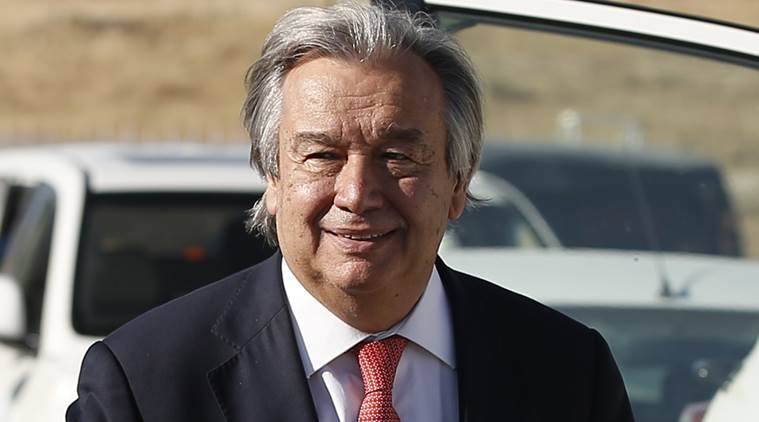
Antonio Guterres

A humanist, a listener, António Guterres, ex-Prime Minister of Portugal, ex-Director of UNHCR, the UN High Commissioner for Refugees, ex-President of International Socialist, has been sworn in as United Nations Secretary-General, over the UN Charter. A new chapter in world history is due to begin with a hands-on, people person in charge.

The United Nations gains more than a breath of fresh air with the appointment of the Portuguese ex-Prime Minister and ex-UNHCR Director, António Guterres, as the next Secretary-General. The UN gets a free thinker, a man of integrity and courage, someone who is more than an apparatchik, someone who can make a difference, a people person.

António Guterres fought his winning election campaign to lead his Socialist Party to victory after ten years of governance by the PSD, or Social Democrats, under the then PM Aníbal Silva, had led the country to breaking point, with the expression "The Portuguese are not a business. They are people". That expression sums up António Guterres.

Brilliant student
António Guterres, born in 1949 in Lisbon, was a brilliant student - in fact he was awarded the country's best student award in 1965, before entering the prestigious Technical University (IST) where he graduated with a 19 out of 20 in physics and electrical engineering. He started his life as a professor, but after the Revolution in 1974, joined the Socialist Party and dedicated himself to politics.

Coming from the Catholic Socialist area, he rose through the ranks and became General Secretary of the Portuguese Socialist Party from 1992 to 2002, and Prime Minister of Portugal (twice) from 1995 to 2002. Simultaneously he was President of International Socialist from 1999 to 2005, then United Nations High Commissioner for Refugees from 2005 to 2015.

His discourse has always been to gain the trust of the people through understanding the people and working for them, leading by example and practising inclusive politics, working towards understanding, working against marginalization.

Working as a volunteer helping poor children
But there are two other stories coming out of Portugal which also place António Guterres, the person, in a nutshell. One is the fact that his own neighbor in his block of apartments in Lisbon had no idea that he was the ex-Prime Minister, or even that he worked at the UNHCR - she thought he was just another transparent, anonymous regular guy...and the other came from a mutual friend.

The day after António Guterres resigned as Prime Minister (after an arguably weak showing in the municipal elections - Guterres understood that petty domestic politics was not where he wanted to stay), this friend asked me if I knew where Guterres was. I said no. Then he asked "And do you know what he is doing right now?" I said "No, I suppose he is relaxing and enjoying real life after politics?" "No, I will tell you where he is and what he is doing. Right now, he is sitting with children from poor social backgrounds, helping them with their math homework in a voluntary coaching center, working as a volunteer, helping poor kids with their studies".

This is the António Guterres I introduce you to, a people person. And more than this. At the time he did not tell anyone, nor did he wish anyone to know, what he was doing. A remarkable man, a remarkable person, as the world is about to find out for itself.

António Guterres, the People Person, represents the very thing the international community needs at this delicate moment in time, namely dialogue, debate and discussion, the fundamentals of democracy. The personal history of António Guterres, chosen as the next Secretary-General of the UNO, makes him the G-spot in international relations.

António Guterres' personal political epitaph stands in Portugal over a decade after he resigned as Prime Minister after winning two elections, and that epitaph is one of a compassionate, caring and thoughtful leader who aligns himself with and feels social issues, favoring an inclusive and egalitarian society and striving to achieve these ideals not only in his public and political life, but also in his personal time. He is a man of principles, of values, of action and courage. He stands against the vested interest, he stands up against the lobbies and looks them square in the eye.

Guterres is no Portuguese pushover, he represents one of the world's oldest nations, home to one of the most widely spoken languages worldwide, the Super Power of the 1500s, which built 3,000 fortresses between Ceuta and Malacca, dominating the coastline around Africa, Arabia, Persia, India and Asia and across the Ocean, giving itself Brazil (by Tordesillas) before it was officially encountered in 1500.

Compassionate and caring
His compassion and caring stem from his personal approach, which is forming consensus through sharing ideas and this means respecting the fundamental precepts of democracy - debate, discussion and dialogue over the ABC of prepotence, the Arrogance, Bullying and Chauvinism approach favored by NATO - and respecting international law, namely following the terms of the UN Charter and not breaching it, another approach favored by the USA and its sickening NATO lapdogs in Europe.

If we take a good look at the world around us today, we see multiple examples of why conflicts have started and continued, and the bottom line is a lack of dialogue. Once again we have two "sides" - the broad coalition called NATO, led by the FUKUS Axis (France-UK-US) and the defenders of the social model, those who respect the hearts and minds of the citizens of the world, namely the BRICS, most of Latin America, most of Africa, most of Asia and most of Oceania.

Let us hope that António Guterres takes the position followed by the Humanists in the international community, which is very much the position and approach defended by the Russian Federation, by the PR China, by Brazil and most of Latin America, by India, by Malaysia, by Indonesia and most of Asia, by South Africa and most of the African continent, namely a multilateral approach to crisis management, sitting all the players round a table and reaching an agreement, achieving peace, development and education - rather than war, destruction and deployment of troops.

This peaceful approach is evidently not possible with the unilateral, holier-than-thou, top-down approach adopted by the powers which only yesterday were drawing lines on maps and ruining lives and livelihoods of entire peoples over many generations. These are the ones that practised and enriched themselves by slavery, these are the ones that practised colonialism and imperialism, carving up communities, stealing resources.

When they told me that the Bulgarian Kristalina Georgieva, who was fast-tracked into the list of contestants for the UN top job, was the favorite of Merkel, Nuland and the heads of the IMF and World Bank, and when they told me that António Guterres had won against these odds, something smiled in my heart. Something smiled for the future.
Timothy Bancroft-Hinchey
Pravda.Ru 
Twitter: @TimothyBHinchey

CUBA WILL BE YOUR MONUMENT
Commandante Fidel Castro
By Yudy Castro Morales 
Neither squares nor streets with your name. No effigy to lay flowers. Detached from the coldness of statues. Distanced from marble and bronze which, inert, erode with time. Your ideas multiplied in men and women, that will be your monument.

You loathed any semblance of a personality cult, any excess of veneration, for it is something of the greats to not appear to be so, and leave the glories, sublime or epic, trapped in small kernels of corn. The continuity lies in planting them.

I am one of those who imagined at least one sculpture, dressed as a guerrilla, atop a mountain in the Sierra, looking out into the distance, some say into the future. There where you used to come and go.

During your pilgrimage through every place that the caravan once baptized with liberty, the legend of your immortality grew, of your eternal presence, beyond exaltations or idealizations that forget the material with which heroes are made: flesh and bone. It became clearer just how a man becomes a people, how history reveres him and how his ideas, all of them, are born of what is just.

And for me, that singular space where I could adore you became less necessary.
After all, milimetrically designed, it will not exist, beyond that rock with a heart of your ashes. But there will be an entire Cuba to cast your lot with, with each of her corners and streets to remember you.

When we see an unusual gathering or a long queue, we will ask ourselves whether you are going to speak; when we hear of some injustice or delayed response we will say that in your time, that would not have happened, at least if you knew about it; when we want to go to the root of problems, understand everything, and risk everything to save it all, we will say that is what you did. And you will continue to be born in everything that appears fatuous to us, in every perfectible work that will dignify us.

Long before your departure, there were many who, hanging your picture on the wall, asked you for miracles as one asks a god, or asked a god to take care of you, to give you health and a long life, because your existence was an anchor to their faith. Now there will be little to ask for and much more to do. And we will have to build the “miracles” with our own hands.

In his song to you, which has become an anthem during these days, Raúl Torres said that he had seen striding “in front of the caravan, slowly without a rider, a horse for you.” And Changó, that orisha of strength and justice that the Yoruba religion celebrates, rode on horseback, just as you decided to imbue a rock with the life of a warrior.

There will be no school, hospital, or avenue with your name. A country will be your monument. A country moving forward.

SWEDEN RUNS OUT OF GARBAGE
Apparently, Sweden has run out of garbage and have now been forced to import rubbish from other countries to keep its state-of-the-art recycling plants going.
The Scandinavian country’s recycling system is so sophisticated that only less than 1 per cent of its household waste has been sent to landfill last year.

The country sources almost half its electricity from renewables.
“Swedish people are quite keen on being out in nature and they are aware of what we need do on nature and environmental issues. We worked on communications for a long time to make people aware not to throw things outdoors so that we can recycle and reuse,” said Anna-Carin Gripwall, director of communications for Avfall Sverige, the Swedish Waste Management’s recycling association.

Sweden, which was one of the first countries to implement a heavy tax on fossil fuels in 1991, has implemented a cohesive national recycling policy so that even though private companies undertake most of the business of importing and burning waste, the energy goes into a national heating network to heat homes through the extremely cold winter.

“That’s a key reason that we have this district network, so we can make use of the heating from the waste plants. In the southern part of Europe they don’t make use of the heating from the waste, it just goes out the chimney. Here we use it as a substitute for fossil fuel,” Gripwell was quoted as saying by the Independent.

“There’s a ban on landfill in European Union countries, so instead of paying the fine they send it to us as a service. They should and will build their own plants, to reduce their own waste, as we are working hard to do in Sweden,” Gripwall said.

“Hopefully there will be less waste and the waste that has to go to incineration should be incinerated in each country. But to use recycling for heating you have to have district heating or cooling systems, so you have to build the infrastructure for that, and that takes time,” she added.

Swedish municipalities are investing in futuristic waste collection techniques, like automated vacuum systems in residential blocks, removing the need for collection transport, and underground container systems that free up road space and get rid of any smells, the report said.

Friday, 16 December 2016

NPP COMPLAINS: It Says the Electoral Register is Still Bloated

Mr Peter Mac Manu
The opposition New Patriotic Party (NPP) won the 2016 polls on bloated register, the party’s campaign manager, Peter Mac Manu has said.

The NPP in August last year claimed that following a painstaking investigations it had conducted it discovered that the 2015 Togolese voters’ register has 76,286 “potential matches” on that of Ghana’s.

This led to the purging of about 50,000 names from the 2016 voters’ register ahead of the conduct of last week’s polls that saw the election of the presidential candidate of the NPP, Nana Akufo-Addo as Ghana’s president-elect.

“…There’s been a lot of issues that post elections analysis would have to bring out. There’s been issues of bloated register and I still maintain that Ghana’s voters register is bloated,” said Mac Manu on Monday in an interview with Accra-based Joy FM.

The NPP over the years, he said had complained about the register that it cannot understand why out-going president, John Mahama garnered a whopping 400,000 more votes “over his parliamentary candidates” in the 2012 elections.

When asked by Kojo Yankson, host of Joy FM’s Super Morning Show that he [Mac Manu] thought the NPP won the 2016 polls on a bloated register, Mac Manu replied that “of course the register is bloated and I won’t deny that.”

“But we prevented the excesses from being played out on voting day,” he added.
That notwithstanding, he stated that the NPP won the elections as a result of the need for change that percolates every sphere of the country.

He said in “…2008 and 2012 elections were quite different and different from the 2016 election. If you look at the political environment; the electoral environment, the economic environment, the security environment - they’re different."

“…So you have to update yourself and measure up to the current environment to be able to take advantage because it is a competition… a competition of ideas and the key person in this whole saga of elections is the voter. So you have to measure up to the concerns and needs of the voter and you are going to meet it and that’s exactly what the New Patriotic Party did for the 2016 elections,” he added.

Editorial
SO FAR, SO VERY GOOD
Out-going President John Dramani Mahama and in-coming President Nana Addo Dankwa Akufo-Addo appear to be handling the transitional process very well.

They have all placed emphasis on the need to pursue what they have described as the broader Ghanaian interest with a focus on how to improve the living and working conditions of the people.

President Mahama whiles acknowledging defeat pledged to do all he can to ensure a smooth transition of power to the new administration.

Nana Akufo –Addo on the other hand has told his supporters that he would not be an NPP President but a president for all Ghanaians.

All these are very reassuring even though the transition period has also seen several cases of politically motivated violence.

It is our hope that the goodwill being exhibited by the leaders can help to end the needless violence and create conditions for Ghana’s forward march.
So far, so very good.

Independent Prosecutor Will Fight Corruption Efficiently – Nana Addo
President Elect, Nana Akufo Addo
By Delali Adogla-Bessa
President-elect Nana Akufo-Addo, has reiterated the point that his incoming administration will establish an independent prosecutor’s office to deal with corruption in his administration.

Nana Akufo-Addo contends that, an office devoid of political influence will assist in arresting the issues of corruption that have plagued Ghana.

In an interview with the BBC, the President-elect said such a move would also allay the fears of witch-hunting of political opponents.

“We have decided that we want to take the politics out of it [the fight against corruption], so that the screams of witch-hunting and others will not arise, by establishing an office of a special prosecutor or somebody who will be independent of the executive and whose remit will be to investigate and tackle issues of corruption.”

“Hopefully, that person is going to be somebody who is going to command the respect of the society, and at the same time has an independent mind to make the decisions,” he said.

Fixing economy a priority
Aside the efforts to establish an independent prosecutor’s office, Nana Akufo-Addo indicated that, his main priority will be fixing the economy and addressing the youth unemployment rate in the country, which the world bank has pegged at 48 percent for persons between ages 15 and 24.

“Unemployment amongst the youth has reached alarming proportions, and if we don’t find a method of dealing with it, our country and society are going to run into all kinds of problems down the line. So my major priority is what we need to do to get our economy working again, expanding and growing rapidly,” Nana Akufo-Addo said.

Why I lost Navrongo Central seat - Mark Woyongo
Mark Woyongo
Defeated lawmaker for Navrongo Central in the Upper East Region, Mark Owen Woyongo says it not strange losing the seat though he least expected to have been defeated in that manner.

According to him, there is no strange feeling losing the seat since this is not the first time he has contested an election on the ticket of the party and lost in the same constituency.

He states that the defeat was not expected considering what he had done in the area under his tenure blaming it on the delays in the release of feeding grants to second cycle institutions leading to intermittent closure of schools.

“My area is full of educational institutions and this is one of the reasons that caused my defeat. During my campaigns, everywhere I went the people complained about it and nothing was being done to improve the situation”, he disclosed on the Ultimate Breakfast Show hosted by Lantam Papanko.

The Former interior minister also stated that the introduction of certain policies by government including the scrapping of teacher and nursing allowances worked against his candidature coupled with the astronomical increase in electricity and water tariffs.

“As I said earlier, there were a combination factors including the lack of jobs for the teeming youth, the failure and complacency of some party executives to work because they felt we had done much and there was no need to stress themselves and government policies affected my fortunes”, he added.

NO MILITARY SOLUTION TO PALESTINIAN CONFLICT
Jennifer Lartey
By Duke Tagoe
The Government of Ghana has expressed grave concerns about the deteriorating state of affairs regarding the peace process between the states of Israel and Palestine insisting that there is no military solution to the Palestinian conflict.

In her address at the Palestinian Embassy to mark the International Day in Solidarity with the Palestinian people, Mrs Jennifer Lartey, Director for Middle East, Asia and Pacific Bureau of the Ministry of Foreign Affairs said Ghana believes the Palestinian question is at the core of the Middle East conflict and has in practical demonstration of this belief, extended consistent support for various United Nations General Assembly resolutions on the issue.

According to her, President John Dramani Mahama, emphasied Ghana’s support for a two state solution to the Israeli-Palestinian conflict at the last United Nations General Assembly adding that Ghana will continue to express its solidarity with the people of Palestine in their quest for self-determination and their desire to live in an independent state side by side with their neighbours.

Mrs Lartey warned that “Israel’s security can only be guaranteed by a peaceful and stable Palestinian state” and urged the international community to renew or resolve to increase and sustain the contributions made towards the realization of the Palestinian cause.

Recounting historical landmarks in Ghana-Palestine relations, Mrs Lartey said Ghana was amongst the first countries which recognized the state of Palestine when it was formally proclaimed in 1988.

Ghana, she said “has consistently extended support to and demonstrated her solidarity with the Palestinian people in their struggle for self-determination and the creation of an independent homeland for their own people of Palestine.”

A Human Rights Watch report for the year 2016 states that the Israeli occupation and its forces led by Benjamin Netanyahu, “fatally shot and killed at least 96 Palestinian civilian and wounded at lease 10, 854 in the West Bank.”

The report also states that: “In June, a UN commission of inquiry released a report regarding the 2014 Israel-Gaza war that found Israeli forces committed serious laws-of-war violations, including attacking residential buildings without an apparent military target, using artillery and other high explosive weapons indiscriminately in populated areas, and apparently targeting civilians not participating in hostilities.

“As of November 23, Israeli authorities demolished 481 Palestinian homes and other buildings in the West Bank (including East Jerusalem), displacing 601 people, including 296 children. In August, Israel demolished 22 homes in four communities in an area that Israel has designated for future settlement construction, called E-1. These communities are among 46 Bedouin villages Israel has earmarked for forcible “relocation” to three sites in the West Bank.”

The International Day of Solidarity with Palestine has been set aside by the United Nations and is observed every year because on that day in 1947, the general assembly adopted resolution 181 which provided for the establishment in Palestine, a Jewish State and an Arab State.

AN UNDEFEATED FIDEL INSPIRES US WITH HIS EXAMPLE
Commandante Fidel Castro Ruz
By Eduardo Palomares Calderón |
"All the glory in the world would fit within a kernel of corn," wrote Cuba's national hero José Martí, but today it seems that all of the glory in the world fits in a small cedar chest draped with a Cuban flag, bearing a simple inscription: Fidel Castro Ruz, with no letters indicating military rank or position, that weighed heavy in the hearts of those present in this city's Antonio Maceo Grajales Plaza de la Revolución.

It was not in vain that Fidel united dozens of leaders from sister countries and more than a million Cubans in Havana, moved an entire people along the funeral procession that followed the route traveled by the Caravan of Liberty in 1959 - this time in reverse - and concentrated in this heroic city more dignitaries and friends from abroad and hundreds of thousands of Cubans from the country's eastern provinces.

"I am Fidel!" was the cry that emerged from the hearts of those moved by the national anthem, because only an undefeated Comandante en Jefe, who inspires us with his example, is able to reproduce himself in men, women, and children committed to continuing his work and making his ideas their own.

As witnesses Fidel had, along with his family and brother - a comrade in all battles - a Black brother who faithfully accompanied him in ideas and action, Juan Almeida Bosque, immortalized in a sculpture on the Heredia Theater flanking the Plaza, as well as the Bronze Titan Antonio Maceo whose likeness calls us to battle.
Thus the pain, the sadness, the silence accumulated over the days since the night of November 25, were during the final tribute transformed into the determination to honor Fidel with commitment.

HIS WORK WILL LIVE ON IN THE HEARTS OF WORKERS
In the name of Cuba's working class, Ulises Guilarte de Nacimiento, general secretary of the Cuban Workers Federation (CTC), expressed the deep pain and sadness felt by the trade union movement following the death of the founder of the Cuban Revolution, Comandante en Jefe Fidel Castro Ruz.

He said that Fidel was a "political giant of the 20th century; a member of a generation which was able to cultivate loyalty and determination, with its words and actions, and which defended revolutionary ideas and the principles of social justice unconditionally. From him, we learned that only those who struggle have the right to triumph, and the deep conviction that achieving victory depends on leadership, motivation, and the conception of unity we are able to generate within the people and among workers.

"With the triumph of January, 1959, the Cuban working class not only found a solution to its work-related demands and took power, but also became the leading force in the transformations required for the construction of a new social project, on the basis of which unity in the defense of the nation's interests was created."
At another point in his remarks, Guilarte said, "Thanks to you (Fidel) Cuba is today an honorable, independent, anti-imperialist, and solidary country.
"Your work will live forever in the hearts of workers. With your untiring struggle, you have shown that a better world is possible."

FIDEL, FOR CUBAN CAMPESINOS, YOUR WORK AND THOUGHT WILL ALWAYS BE A BEACON AND GUIDE US IN THE DEFENSE OF OUR SOCIALIST REVOLUTION
Rafael Ramón Santiesteban Pozo, president of the National Small Farmers Association, said that since the first moments of the struggle in the Sierra Maestra, campesinos have had confidence in Fidel and in the nascent Rebel Army, noting the multiple ways in which they supported the insurgent forces. "Many of them joined as soldiers and gave their lives for a Revolution that defended their rights and was going to truly liberate them."

He emphasized that the Revolution's Agrarian Reform was not only implemented, but went further, giving ownership of the land to the men and women who worked it; as well as bringing science and technology to the fields; ensuring credit to finance production; providing insurance; taking education, public healthcare, sports, and culture to the most remote corners of the country; and most importantly gave us the independence and dignity that only a free, sovereign nation can.

He added, "Fidel, for Cuban campesinos, your work and thought will always be a beacon and guide the defense of our socialist revolution and its achievements. You will always be present, and we will follow you as we contemplate with affection every luminous dawn in our fields, among palms, plains, and mountains, in the effort and sacrifice of every workday as we fertilize the soil to continue cultivating your legacy."

VETERAN COMBATANTS WILL CONTINUE YOUR WORK WITH SACRIFICE; COURAGE & REVOLUTIONARY CONVICTION
Division General José Carrillo Gómez, who heads the Association of Combatants of the Cuban Revolution, said that members of the organization were deeply moved by the loss of their Comandante en Jefe, undefeated in all of the Cuban people's battles in diverse arenas, since the last stage of our definitive national liberation struggle began.

He likewise indicated, "The Revolution which you dreamed of, initiated, and carried out, to which you tirelessly devoted your entire life, we will carry forward with absolute loyalty, united in an unstoppable march, like Martí, Maceo and Gómez, onward to conquer all justice and make the golden dream of our Apostle, of yours, and of all honorable Cubans, a beautiful reality."

General Carillo said, "Veteran combatants will continue the work with sacrifice, courage, and revolutionary conviction. We face the challenge of being worthy of all those who died for the homeland, from the heroic martyrs of Moncada to those who fell in our glorious internationalist missions.

"Everyone, in a monolithic bloc, veterans and youth, reassert that the best way to pay tribute to Fidel is to maintain our unity under all circumstances, and reaffirm our commitment to making a reality of the conception of Revolution he formulated."

WE ARE ALL FIDEL
Carlos Rafael Miranda Martínez, national coordinator of the Committees for the Defense of the Revolution (CDR) stated that Fidel is Cuba, because Fidel is the people, who continue to love him and are willing to follow him, just like they have done in great battles. “What Cuban doesn’t have in their home, on their desk, in their bedroom, on their dresser, a picture of their leader? He entered into our lives forever and became part of our family.”
At another moment, Miranda noted that the Committees, and of course Fidel, are present in every young person over 14 years of age that joins the organization, in every drop of voluntarily donated blood, in every mobilization to participate in vaccination campaigns, electoral processes, community debates, in every act of voluntary work.

Expanding on this idea he stated, “We are all Fidel. Eight and a half million Cuban men and women accompany me tonight, all CDR members. I speak on behalf of all of them. On behalf of the retirees and homemakers, the doctor, the police officer, the youth and students, recent graduates, carpenters and builders, artists, that is to say, every member of the community, the ordinary people of our neighborhoods.”

WE CUBANS ARE THE REVOLUTION 
Representing the Federation of Cuban Women, the organization’s secretary general Teresa M. Amarelle Boué, emphasized that Cuban women have every reason to be proud of the country’s achievements. She noted that “given the values and principles of socialism which characterize the Revolution we defend, FMC members throughout the country have signed your concept of Revolution, as a way of reaffirming the fact that you have entered into immortality, because although your physical body is gone, your ideas and unquestionable truth will take root in every new generation of women born on this island. We feel a sense of commitment for having lived in your time, Fidel, and to continue building the extraordinary work you created.

“We Cuban women are the Revolution! Because it was she that opened the path of liberty and justice to us, because it was she that gave us the opportunity to become full human beings with rights and protagonists of the new Cuba built by you and the vanguard army that you so nobly led, which ripped out decades of discrimination, exclusion and humiliation by the root.

“Fidel is reproduced – as you (previous speakers) have said – in every patriot that stands up against imperialism and cultivates dignity and compassion. You have not died Fidel! You live in every Cuban woman, in our children, in our grandchildren; you live in every revolutionary of your grateful homeland and the world.”

FIDEL WENT TO THE VERY ROOT OF HISTORY TO EXTRACT ITS MOST NUTRITIOUS ESSENCE
Meanwhile, Miguel Barnet Lanza, president of the National Union of Writers and Artists of Cuba, reflecting on the figure of Fidel, stated: "None of his contemporaries can measure up to his stature as a giant. He defined for our country a new concept of nation, and as such contributed to the creation of a modern conception of the true meaning of revolution. He went to the very root of history to extract its most nutritious sap. As a young university student he fought against the evils of the neo-colonial Republic. His strong inclination toward the ideas of Martí saw him regarded as a leader and example among his peers."

“This was Fidel the statesman, but the intellectual was never far behind. In his historic “Words to intellectuals,” he outlined Cuba’s cultural-political program, with a democratic and inclusive vision. The literacy campaign was carried out - the Revolution’s first great cultural achievement - and created were institutions which promoted the arts and letters, such as ICAIC; the Casa de las Américas; the Union of Writers and Artists of Cuba; the artistic education system; and a group of institutions which have supported the country’s development. 

“Books ceased to be a privilege and became an essential item. The entire program, all of it, was Fidel’s idea and one of his greatest legacies. And in the most difficult moment of the Special Period, as we were approaching rock bottom, the maxim he used to close a UNEAC Council was “Culture is the first thing that must be saved.”

FIDEL LEFT IN US THE INSPIRATION TO CONTINUE EXISTING; TO CONTINUE FIGHTING ON
Jennifer Bello Martínez, president of the Federation of University Students, stated that for Cuban students Fidel symbolizes strength, energy, faith in the Revolution, and commitment to the homeland. “The need to feel the pulse of his words, his ideas, his piercing gaze, the gesticulation of his hands, and firmness of his steps, has increased over these days: Fidel left in us the inspiration to continue existing, to continue fighting on.”

She also noted that the Comandante became a revolutionary at the university, “in the same expanding university where generations of young students today find meaning in life, which translates into a rebellious spirit, profound ideas of justice and human dignity, in an enduring social commitment.

“We will always defend this Revolution, we will never allow the sword or the flag to fall, we students will not fail her. We ratify our commitment to moving toward the future with your principles and ideals. Cuban universities and schools will be our Moncada, our Granma, our Sierra, our Girón. Cuba is ours to look after and defend!

“Before you, Comandante, who motivates us, before the statue of the Bronze Titan and before the people that have come to pay tribute to you, we wish to reaffirm that we will be faithful and loyal continuators of Martí; that we will be faithful and loyal continuators of Maceo. And with them, we Cuban students today state, for you, for Raúl and our Party, that Cuba is and always will be our eternal Baraguá.”

WE WILL CONTINUE TO BE FAITHFUL TO HIS LEGACY AND NEVER BETRAY THE CONFIDENCE WHICH HE ALWAYS PLACED IN THE YOUTH
Speaking during the tribute to Comandante en Jefe Fidel Casto Ruz, Susely Morfa González, first secretary of the Young Communist League (UJC), noted that millions of Cubans and revolutionaries across the entire planet have grown up with the lessons of the Comandante en Jefe. “We learned that principles must be unbreakable, that surrendering is never an option; that being an anti-imperialist is the essence of our historic struggles, that solidarity and internationalism make us grow as human beings and give us the overwhelming satisfaction of feeling useful; that all the glory in the world fits within a kernel of corn, and that we must never lie.”

She also highlighted that henceforth UJC members will assume an even greater commitment to Fidel’s ideas and revolutionary concepts, “We will be better in our studies, at work, in defending the homeland, much more altruistic, committed, and unwavering, we will feel that in every one of us continues the always perfectible work of true revolutionaries such as he, those who find the greatest satisfaction carrying out our duty.

“Our dear Fidel marches toward immortality, and today, overcoming the pain, we new generations of Cubans reaffirm that we will always be faithful to his legacy, and never betray the confidence which he always placed in the youth.”

The World Highlights Cubans’ Commitment To Fidel’s Legacy
By Granma International news staff | informacion@granma.cu
More than a month after the death of Comandante en Jefe Fidel Castro Ruz, important figures, global communities, and media outlets continue to highlight the legacy of the leader of the Cuban Revolution and Cubans’ commitment to his ideas.

A crowd of people gathered in the French capital to reaffirm their decision to continue struggling for just cases, guided by Fidel Castro’s thought.

There in Paris’ José Martí square, French, Latin American and Cuban citizens noted that despite the death of the Comandante, his legacy will live on and accompany the struggles of the nation and those of peoples across the world, reported Prensa Latina.

Didier Philippe, president of the Cuba-France Solidarity Association, stated that “This immense man will always be remembered as a key actor of the 20th century, and defender of oppressed peoples in Latin America, Africa and Asia.”

Meanwhile, French intellectual Paul Estrade highlighted Fidel’s efforts to secure Cuba’s independence, return dignity to his people, and guarantee important rights such as access to healthcare and education.

Numerous tributes have been held across the European nation since the Comandante’s death, last November 25, to commemorate the mark left by the leader on thousands of French citizens.

On December 4, the Cuba solidarity movement in Spain also held a public tribute to bid farewell to the revolutionary leader, whose ashes were laid to rest the same day in Santiago de Cuba’s Santa Ifigenia Cemetery, but whose legacy will forever remain in our collective memory.

”He leaves a work. He leaves an honorable, noble, courageous and solidary people,” stated Cuban Ambassador to Spain Eugenio Martínez, after expressing thanks for the numerous expressions of respect and admiration which have been arriving to the Embassy over the past week.

For his part, Comandante José Luis Merino, a Salvadoran revolutionary and one of the founders of the Farabundo Martí Front for National Liberation (FMLN), noted that dignity is one of Fidel Castro’s most important lessons.

Speaking with Prensa Latina, he emphasized the significance of Fidel in El Salvador’s revolutionary process.
“He helped us to develop our political-military thought so that the FMLN not only functioned as a military guerilla force, but also as a political force, and above all a force of great humanity,” he added.

Meanwhile, governor of the Venezuelan state of Yaracuy, Julio León Heredia, awarded the Cuban revolutionary the Ezequiel Zamora General of the Sovereign People Order, also on December 4. Heredia visited the Cuban Embassy in Caracas to present to posthumous honor to Fidel.

Speaking to the press, the official noted that the Order, the highest distinction awarded by the north-central state, represents a gesture of gratitude for the legacy Fidel left to Venezuela and the peoples of the world.

From Vietnam, representatives of the Cuba Friendship Association recognized the work of the man who will always be remembered in that nation as a true friend.
In Santiago de Chile thousands of citizens gathered together at the José Martí monument in the capital’s central Plaza Italia, December 4, where participants paid a moving tribute to the historic leader of the Cuban Revolution.

Speaking to PL, Javiera Olivares, president of the Journalists Association in Chile, noted that although the passing of the Comandante represents a sad moment, Fidel leaves an extraordinary legacy for the people of the world.

We will always remember him by continually reviewing his writings, his speeches, and his skill as a visionary, his example for all of humanity, stated Olivares.
“Hasta siempre Comandante, immortal example in the heart of Chileans,” could be read on a screen during the activity which saw the participation of the Nicaraguan Ambassador to Chile, María Luisa Robleto and various leftist political leaders, Cubans living in Chile, doctors, professionals and Chilean trade unionists.

Fidel Castro represents the Latin American revolution, he was a man that persevered and achieved his goals based on maintaining his principles and values, stated Bolivia’s Minister of Economy, Luis Arce, speaking with PL at the Cuban Embassy in La Paz.

For us Bolivians Fidel is an example to follow and we will remember him as we build this new socialist homeland in Bolivia, he stated.

The International press also highlighted the patriotic fervor of Cubans who took to the streets with flags, doves, handkerchiefs, and signs, to bid farewell to the eternal Comandante.

According to Mexican newspaper La Jornadathe mass mobilization of Cubans in honor of Fidel not only represented a people in mourning but also hope.
The paper reported that “the vast majority of those who came out to pay tribute in a long period of national mourning, were born or grew up after the arrival of the revolutionaries to Havana in 1959. They are the children of the democratic, anti-imperialist, and anti-Batista Revolution and participated in the heroic efforts to build socialism only a few kilometers from the empire.”

The article went on to note that Fidel Castro’s ashes were laid to rest in Santiago de Cuba’s Santa Ifigenia Cemetery, close to the site where the remains of poet and National Hero José Martí – of whom Fidel is considered a successor - are buried.

Meanwhile, on its website, multi-state news broadcaster teleSUR, posted the remarks made by Army General Raúl Castro, President of the Councils of State and Ministers at the tribute ceremony held on December 3, in Santiago’s Antonio Maceo Plaza de la Revolución, during which he noted that “the undefeated Fidel brings us together with his example that yes, it was possible, yes, it will be possible!”

The news agency also reported that in addition to José Martí, Fidel’s ashes rest beside those of the father of the homeland Carlos Manuel de Céspedes; as well as a plethora of heroes and martyrs from almost a century-and-a-half of struggles for Cuban liberty and dignity.

Chilean weekly El Siglo, official organ of the Communist Party of Chile Central Committee, dedicated an entire edition to the figure of the Comandante en Jefe.
The 20 page publication included details of the revolutionary’s work. With headlines such as “Fidel: the man-the history,” With “One of ours has passed,” and “Fidel eternal paradigm and legend,” the paper retraced various facets of the life of the founder of the Cuban Revolution.

Meanwhile, German news agency DPA, reported on the thousands of citizens from Santiago de Cuba and other eastern provinces who gathered on December 3, in Antonio Maceo Plaza de la Revolución, where continual shouts in support of the Revolution could be heard.
” Hasta la victoria siempre” was one of the main headlines on the front page of Argentine newspaper Página 12, which highlighted one of the most moving moments in the Plaza, when Raúl, quoting Antonio Maceo, stated, “Whoever attempts to conquer Cuba, will gather the dust of her blood-soaked soil, if he does not perish in fight!” (GI news staff)

FIDEL’S DEPARTURE SHOOK ASIA TO THE CORE
Commandante Fidel Castro
By Andre Vltchek
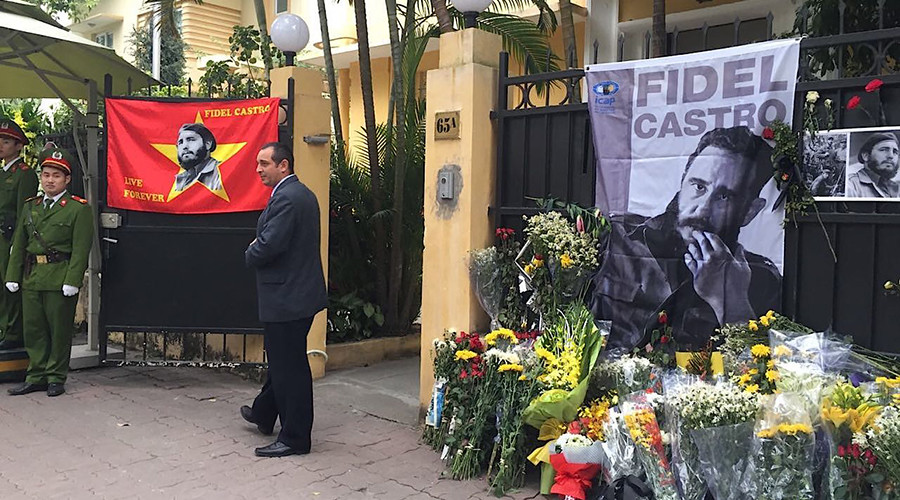
On November 30, I walked into the historic building housing the Cuban Embassy in Hanoi, Vietnam. Several Vietnamese guards stood silently at the entrance. Flowers were everywhere and a big black photo of Comandante Fidel was facing a busy street.

I explained who I was, and an embassy official first let me into a courtyard decorated with more flowers and images, and later into a room with a beautiful book, into which I penned several sentences of grief, but also admiration and hope. 

“People come day and night,” Cuban officials told me. “It is beautiful and humbling. Vietnam and Cuba stood shoulder to shoulder for decades. We went through so much. Now we are being shown what true friendship means!” 

As if it was their national hero who had departed, Vietnam declared December 4 a National Day of Mourning.  

For days now, Vietnamese television has been showing documentary films about Fidel and about the Cuban Revolution. 

“Cuban people are ready to spill blood for Vietnam,” Fidel Castro Ruz declared in his memorable speech during the war. Several decades later, when Cuba was abandoned and stood alone, it was China which rushed to its rescue, and it was Vietnam that extended its hand of friendship. 

Such things can never be forgotten. It is precisely because from such moments, true internationalism is made. 

No matter what crescendo the Cold War was reaching, and even when, for some unfortunate time, the Soviet Union and China were facing each other as enemies, Fidel’s Cuba was working with both communist giants for the liberation of Africa, particularly during Che Guevara’s campaign in the Congo. 

In the end, it was both Cuba and North Korea (DPRK) that fought for and helped to liberate the most oppressed and devastated continent on our planet – Africa. The imperialist United States and Europe never forgave these two countries for their internationalist stand. To demonize them, to destroy them by all imaginable and unimaginable means, to push them into a dark corner is what they have been attempting to do for several decades, with mixed success. 

Cuba may be in Latin America, but in its heart it is daringly internationalist. Its fate is intertwined with Africa and with Asia. 

After the Soviet Union collapsed and everything seemed to be lost, after virtually all eastern European countries betrayed the cause and opportunistically joined the world’s oppressors and imperialists (not even bothering to honor their trade and other agreements with Cuba, North Korea, and Vietnam), China single-handedly saved Cuba. It is not a well-known fact, and definitely something that is not discussed often in ‘polite circles’ of the ‘benign Western left,’ but it is an undeniable historical fact, often mentioned by Fidel himself. 

China did it – altruistically – following Gorbachev’s fit of madness and Yeltsin’s Western-encouraged, glorified, alcoholic orgy, with the destruction of the USSR and several dreadful years of unopposed plunder of the world by the Western Empire, in its aftermath. 
The Chinese people, Chinese government, its intellectuals, and media commemorated the departure of Fidel with powerful speeches, documentary films, and events to honor the exceptional life of one of the greatest revolutionaries of all times.  

Xinhua cited Chinese President Xi Jinping as saying: “The death of Fidel Castro has made the Chinese people lose a close comrade and sincere friend. His glorious image and great achievements will go down in history.” President Xi then concluded that “The Chinese people have lost a good and true comrade. Comrade Castro will live forever.” 

Reading such reports, I grasped how genuine they are. I know intimately both countries – Cuba and China. I realize how much Cuba admires China and how much Chinese people hold Cuba in high esteem.  

In 2013, I spent several days in Cuba with one of my best friends, celebrated Chinese concert pianist Yuan Sheng. He flew in to Havana all the way from Beijing in order to participate in a festival of some of the best pianists from all over the world; the festival was organized by his former professor from the Manhattan School of Music, the legendary Solomon Gadles Mikowsky, himself originally from Cuba. 

The Cuban people treated him with great warmth, and all doors were opened to him. Before he departed, he said:
  
“I am tremendously impressed by the cultural life and art scene in Cuba. I traveled to and performed in so many countries in North America, Europe, Africa and Asia... But what I see here is unprecedented. Music, ballet, arts... Even the art objects that people sell on the street... It all shows how heroic the national character of Cuban people is.

Cuba is also very open-minded and receptive of international culture; there is a constant interchange with the world. The plane, which I took here was bringing an entire delegation of Chinese artists and performers. And that is at the same time as I was coming to take part in yet another festival, which was featuring top international pianists. Coming here, I am helping to deepen the understanding between China and Cuba. And you know, in the last years, many educated Chinese people are fascinated with this island and its artists. When I was talking to my friends back in Beijing, that I am going to Cuba, their eyes widened. They were envious, they kept telling me how lucky I am. They wanted to know, to understand Cuba.” 

Fidel’s Cuba is not only synonymous with excellent medical care, education, social programs, and the determined fight against Western imperialism. It is itself also one tremendous symbol of cultural and artistic excellence and openness. Cuba gave birth to and educated some of the world’s greatest artists. Cuba is also deeply respectful of other world cultures. Its people are obsessed with knowledge and are respectful of how others see and perceive the world. 

Observed from Havana, Asia is just there, almost next door! 
Before Fidel passed away, President Rodrigo Duterte of the Philippines sent his health secretary to Cuba to look at its health care system. 

Even such staunch anti-communist ‘warriors’ and client states of the West like Indonesia (where the Communist Party and communist ideology are banned) at least showed some polite respect, sending condolences to Havana: 
“The government and the people of Indonesia send our deepest condolences for the passing of former President Fidel Castro. May he rest in peace and the people of Cuba be given strength to endure his passing.” 
“Be given strength” by whom? But let’s not dwell on details! 
In India, even under the rule of Prime Minister Narendra Modi, Fidel is still alive – alive and well. 

Binu Mathew, editor of the most important left-wing site on the sub-continent, Coutercurrents.org, sent his thoughts for this essay: 

“For Indians and especially for Indian communists, Fidel Castro was a fellow Indian and a comrade. India grieved at his passing. All Indian media covered his passing in a major way. 
“When Cuba went through a major crisis after the fall of Soviet Union, Indians did a door to door collection of rice and wheat and sent to Cuba 10,000 tons of rice and 10,000 tons of wheat. 

“India was one of the first countries to recognize the revolutionary Republic of Cuba. 
“Cuba and Kerala where communists came to power through elections for the first time ever in the world had similar development visions. Both didn’t go after major industrialization but invested in education and health. Both set a new people-centric paradigm of development. 
“Fidel was a pillar of the Non-Aligned Movement which was co-founded by India’s first Prime Minister Jawaharlal Nehru. The camaraderie between them was famous. They first met in 1960 NAM summit. 

“Castro narrated his experience in a media interview: ‘The first person who came to see me was Prime Minister Nehru. I can never forget his magnificent gesture. I was 34 years of age, not widely known. I was tense. Nehru boosted my morale. My tension disappeared.’” 
This alone is a powerful tribute from Asia. 

The two mightiest countries on the continent, China and India, are mourning. So are hundreds of millions of people in Vietnam, the DPRK, and the Russian Pacific Region, even in tiny nations like Timor Leste. 

In all communist countries and regions of Asia, Fidel is regarded almost as a local hero and leader. In pro-Western, staunchly business-oriented societies, he is viewed as a threat, even after his departure.  

He is respected, however, by both sides; respected for his honor and courage, and for fighting battles that almost no one else would dare to fight. Such valor is highly regarded in Asia. 

Since ancient days in this continent, important thinkers and those who fight for the good of humanity are valued incomparably higher than rich merchants and traders. Honesty is essential. Traitors are not valued much higher than scum. At some point in history, they may be ruling over their nations, but when they ascend to the throne, they start counting, as their days are always numbered. 

True heroes like Fidel live forever, in legends and songs, in hearts and dreams for a much better world. 

Asia remembers. It mourns the great Cuban hero, a great African hero and an Asian hero, an internationalist, Fidel Castro.